With its proximity to the cultural hub of New York City and its quieter suburban and rural landscapes, Connecticut was fertile ground for artists and writers in the period of Modernist movements between 1913 and 1979. Many of these cultural figures are well known through biographical and critical studies. Creative Places seeks to show how place played a significant role in creative work, and how in turn the artists and writers influenced communities in Connecticut.

1371 Farmington Avenue, Farmington
- Winchell Smith, Inc.
- Winchell Smith
-
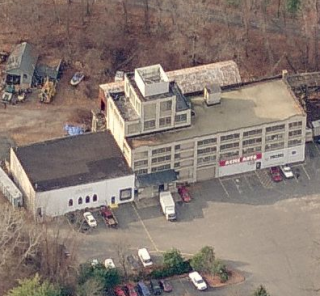
Winchell Smith's grain mill in Farmington where he produced whole-grain flour in the 1920s.
- Description of Significance/Historical Narrative
- Winchell Smith, Incorporated was organized in Farmington, Connecticut in 1923. The business was founded by Winchell Smith, the playwright perhaps best known for his most successful productions, Brewster’s Millions (1906) and Lightnin’ (1918). Smith was born in Hartford, Connecticut and graduated from Hartford High School. He was the nephew of William Gillette, the actor, playwright, and stage manager famous for his stage portrayal of Sherlock Holmes, in whose company Smith began his acting career. After achieving both critical acclaim and financial success during the 1910s, Smith went into semi-retirement in 1920. He took up residence in Farmington, Connecticut, where he had built a mansion, Millstream, in 1917, and pursued the peculiar hobby of grain milling. Inspired by the then popular whole foods movement, Smith purchased an early 18th-century flour mill located along the Farmington River and began milling whole grain wheat, rye, and buckwheat that was sold to Hartford bakeries. Smith also convinced filmmaker D.W. Griffith to shoot Way Down East (1920), starring Lillian Gish, at the site of the mill. Smith organized Winchell Smith, Incorporated in 1923 in order to expand his milling operations, as well as with the future intention of building several theaters and entering the film production business. Most significant to the former was Smith’s decision to erect a $100,000 flour mill and grain elevator along Farmington Avenue near the rail line operated by the New York, New Haven and Hartford Railroad. This was completed in 1924, and was operated by Smith until his business folded in 1931. The building was in turn leased to the Farmington Grain Company, which used it for grain and feed processing and storage until around 1936. By 1940, the property had been occupied by Farmington Farms, Incorporated, a poultry breeder. It is unclear how long this use persisted. The building has since been acquired for use as an automobile parts storage facility.
- Date of Construction
- 1924, ca. 1950, ca. 1980.
- Historic Designation(s)
-
n/a